Apple and Samsung Bet on Gemini: Why Google Is Quietly Winning the AI Platform War
What’s Happening Now
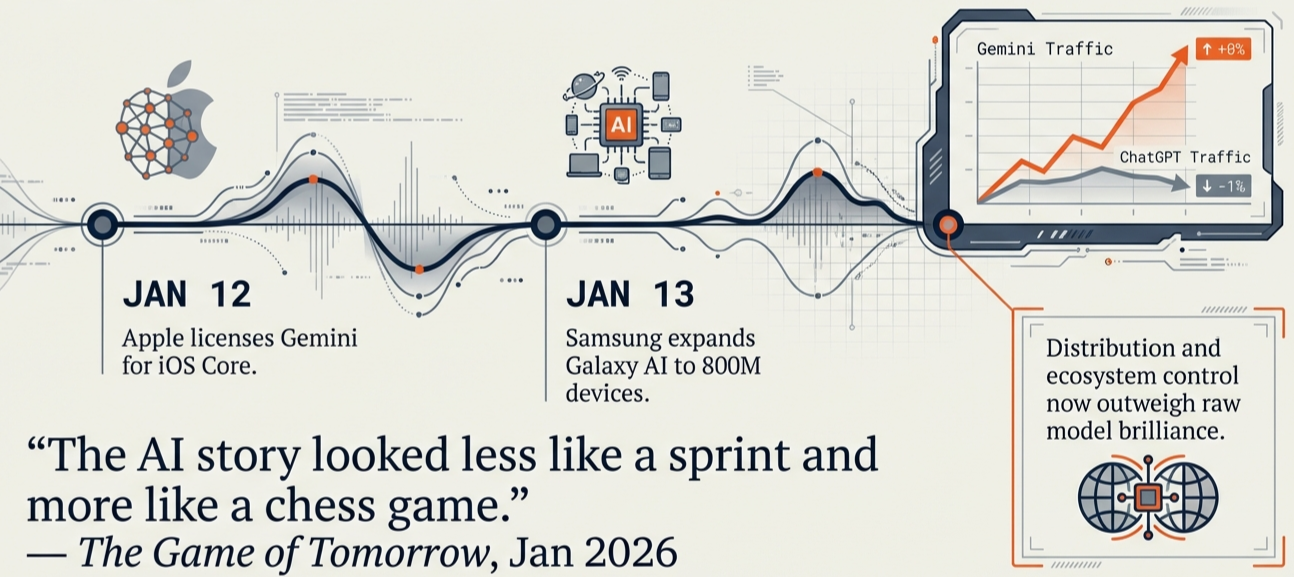
The AI story for January 2026 looked less like a sprint and more like a chess game in which Google quietly moved its queen across every board. In the span of a week, two of the world’s largest device makers—Apple and Samsung—made decisions that read like an endorsement of a single thesis: distribution and ecosystem control now matter as much as raw model brilliance. For Apple, the choice to license Google’s Gemini models for the next generation of Siri and Apple Intelligence features felt like a historic admission; for Samsung, doubling its Galaxy AI footprint to 800 million devices was a full-throated commercial acceleration. The ripple effects were immediate and measurable—Gemini’s presence in the market surged, ChatGPT’s relative share contracted, and the conversation shifted from whose model is smarter to whose AI is most ubiquitous.
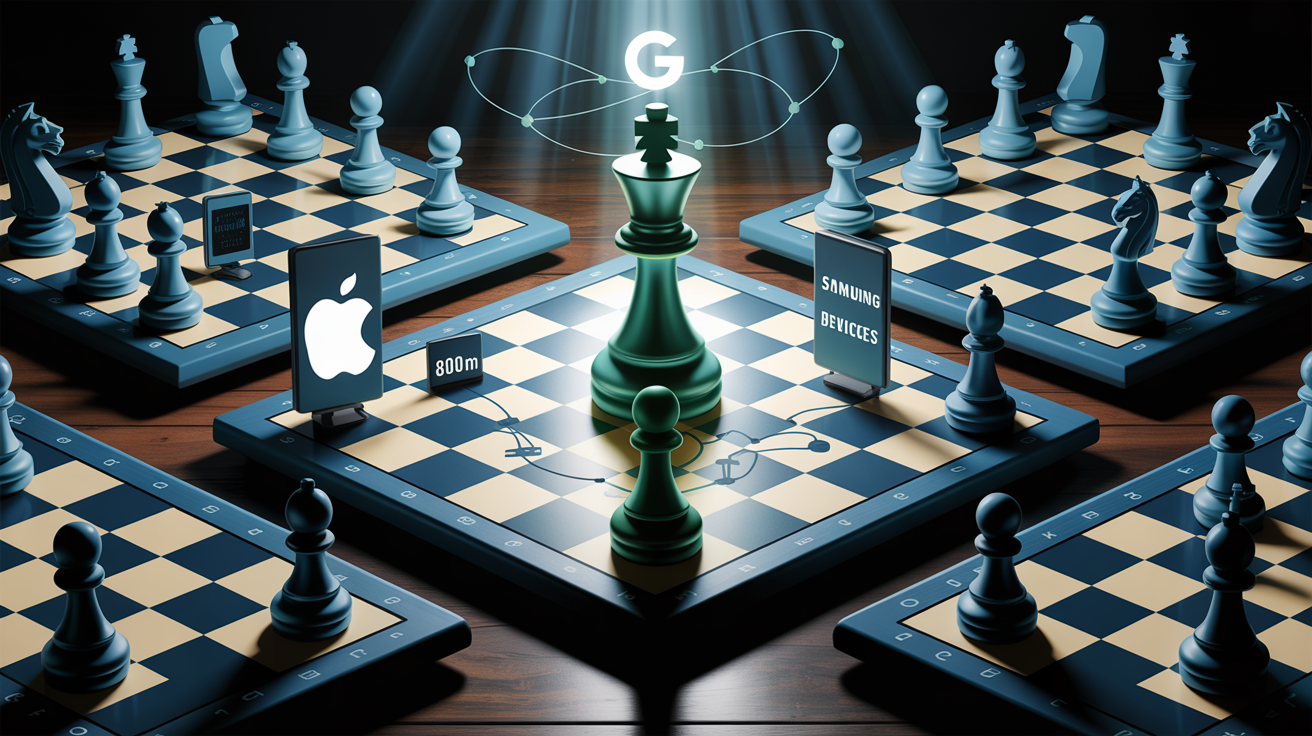
AppleHighStakesPartnership
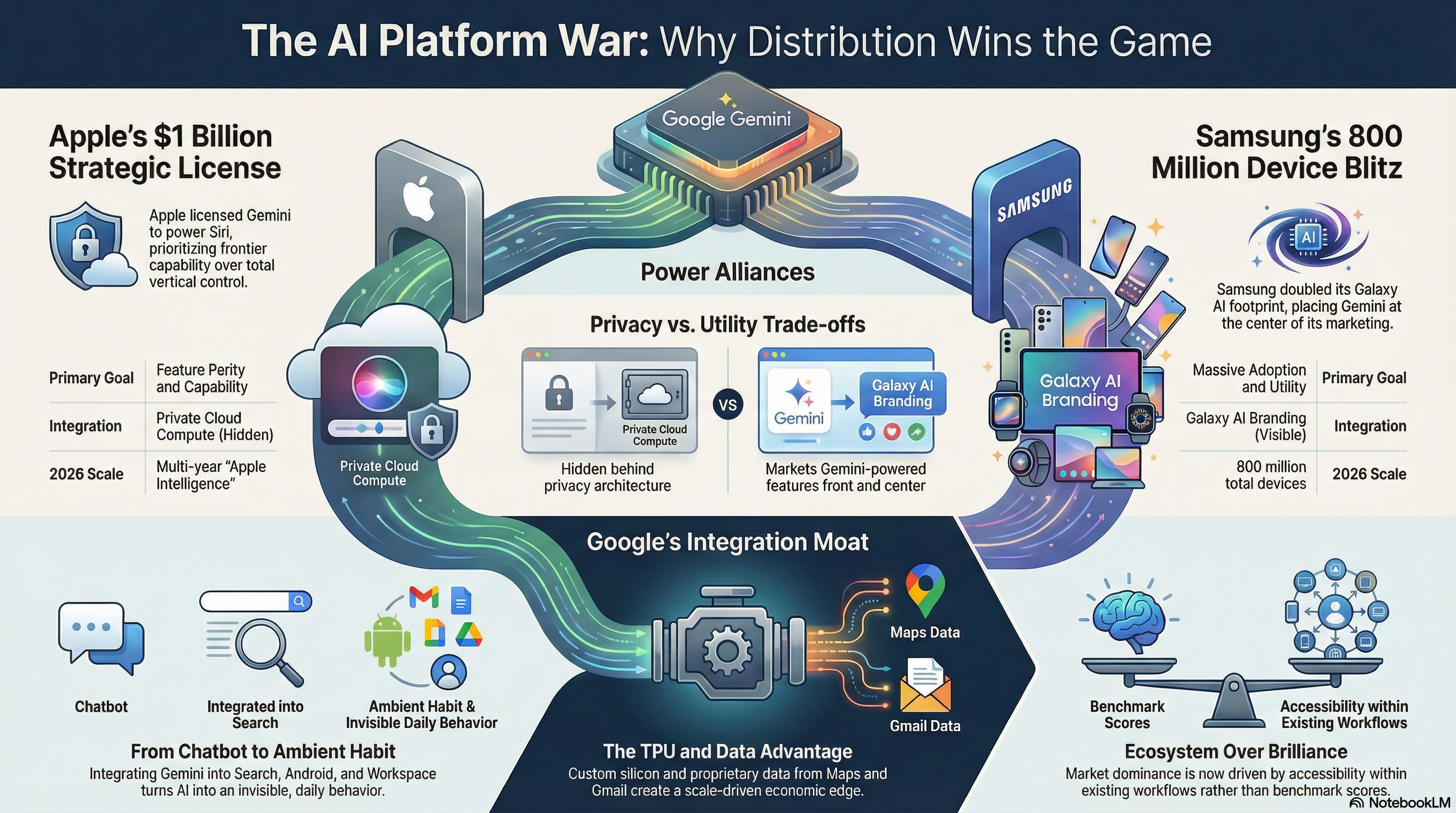
When Apple and Google announced their multi-year collaboration in January, the language in the joint statement did more than state facts—it rewrote expectations. Apple, which seldom admits technical inferiority, explicitly said Geminis provided the most capable foundation for its Apple Foundation Models. That’s a seismic moment: a company that prizes vertical control and privacy choosing to wrap external model capability inside its own branded, on-device and Private Cloud Compute architecture. The reported financial terms—rumored to be roughly a billion dollars a year—underscore that this isn’t a tactical experiment but a strategic long game.
What makes Apple’s approach fascinating is the trade-off it negotiates: access to frontier capability without surrendering the company’s privacy story. Apple will use Gemini to help train internal models and then run features on Apple’s infrastructure, which Apple says will prevent user data from being exposed to Google systems. For Apple, the decision was as much about time-to-market and feature parity as it was about acknowledging where model scale had moved—the gap between a 150-billion-parameter internal model and a 1.2-trillion-parameter licensed model is hard to paper over with engineering polish alone.
SamsungAggressiveExpansion
Across the industry aisle, Samsung didn’t opt for subtlety. The company publicly committed to bringing Galaxy AI to 800 million devices in 2026—doubling the footprint from the previous year—and framed Google’s Gemini at the center of that strategy. Samsung’s public messaging leaned heavily on utility: search, translation, generative image editing, and productivity features that feel like everyday helpers rather than futuristic novelties. Where Apple buried Gemini behind its own brand and privacy architecture, Samsung put Galaxy AI front and center, using the partnership to sell capabilities directly to consumers.
The geography of impact matters here. Samsung’s reach across emerging markets and the mid-tier smartphone segment means Gemini will land in places where users might never have downloaded a standalone chatbot app. Brand recognition for Galaxy AI has risen sharply, Samsung executives say, and the company believes that making AI an obvious, repeated value add will collapse adoption inertia. In short: Apple buys capability and preserves control; Samsung buys capability and markets it loudly. Both bets favor Google.
The Game Of Tomorrow
If the present felt like a tournament of alliances, the near future looks like Google turning its product suite into the stage where modern AI lives. The company’s strategy is as simple as it is patient: integrate Gemini into the fabric of services people already use—Search, Android, Workspace, Photos—and make the assistant invisible, ambient, and indispensable. When an AI is everywhere by default, adoption turns from a user choice into a usage habit.
PlatformIntegrationAndDistribution
Google’s advantage in 2026 is not merely that Gemini scores well on benchmark tests—though it does—but that it lives inside the daily workflows of billions. Embedding generative assistance into Search changes behavior: instead of opening a separate chatbot, users encounter conversational summaries and follow-ups inside the engine they already trust. Workspace integration puts drafting, summarizing, and analysis where knowledge workers spend their days. Chrome and Android become distribution pipelines: a default experience is a powerful kind of marketing you can’t outspend on user acquisition.
This is why Gemini’s market share jump—from a few percentage points into the low twenties for web-based chatbot traffic—matters less for its raw number than for the structural shift it represents. When AI is the reflexive tool inside email, maps, and productivity apps, the friction for switching declines and the cost of remaining outside the ecosystem rises. Google’s model of integration turned product encounters into ambient experiences and, with that, made Gemini the default first touch for a whole class of use cases.
TPUAndDataMoat
Underpinning that distribution play is a stack few competitors can replicate: custom silicon (TPUs), vast data sources (Search, Maps, Gmail, YouTube), and cloud infrastructure optimized for scale. Google’s investment in TPUs and data-center efficiency yields a real economic edge; not every model improvement requires a proportionate increase in unit cost. Running inference at scale matters when AI is embedded in trillions of interactions each month.
Beyond savings, the qualitative advantage is in the data: location signals from Maps, conversational tone from Gmail, and visual patterns from Photos give Gemini domain-specific knowledge that text-only training simply can’t match. This isn’t to say models trained without proprietary data can’t be excellent, but when an assistant must plan a route that considers real-time traffic and local reviews—or summarize a long email thread in context—the ecosystem signals create a competitive buffer that’s more durable than a single benchmark lead.
SearchTransitionAndMonetizationTension
Turning Search into an “answer engine” is transformative—and messy for the incumbent revenue engine. AI-driven conversational results change where attention lands, which in turn changes how ads are bought, sold, and measured. Google is experimenting with ways to bring ads into AI interactions, but doing so without undercutting user trust or the product’s utility is a delicate balancing act. The company faces a paradox: the more helpful the AI, the less users may click through to ads in the old model; yet monetization is necessary to sustain the investment.
This is the commercial calculus behind Google’s strategic patience. If Gemini makes Search more useful, it also creates new forms of commerce—recommendations, direct shopping integrations, and commission-driven referrals—that could replace per-click economics. The winners in this transition will be the companies that figure out formats advertisers accept, and users tolerate, in conversational contexts.
Risks And Rewards
The consolidation around a small number of platforms creates clear winners and visible risks—both commercial and civic. For customers and enterprises, the reward is rapid access to powerful tools that actually change workflows. For competition and policy, the risk is concentration that makes it harder for challengers to build scale without extraordinary capital or a radically different technical approach.
OpenAIDefensivePosition
OpenAI’s “code red” in December—an internal scramble to shore up product quality and pause new monetization experiments—wasn’t theatrics. It was a recognition that market share without stickiness is brittle. ChatGPT still commands loyal, highly engaged users, but when rivals embed comparable assistance into core tools, the battleground shifts to ecosystems. OpenAI’s response has been to double down on model quality, expand persistence and agentic capabilities, and try to convert ChatGPT into a superapp where users do more and thus stay.
That strategy has logic—but it’s also uphill. Building a platform that people choose to center their workflows on is harder than making a best-in-class standalone model. OpenAI’s pause on advertising signals awareness that ad revenue is a poor substitute for product momentum; introduce ads too soon, and you give users another reason to try something else.
EnterpriseAndSpecialistDynamics
Not every market tips to the same duopoly. Anthropic, Mistral, DeepSeek, and other specialists show that focused products and different training philosophies can sustain valuable niches. Enterprises with stringent safety, privacy, or regulatory needs may prefer a partner built around interpretability or on-prem solutions. Open-source models and cost-efficient training innovations keep the possibility of disruption alive: architectural breakthroughs or dramatically cheaper training approaches could re-open the frontier to new entrants.
Still, the platform dynamics favor incumbents. Enterprises already embedded in Google Workspace or Microsoft 365 face lower friction to adopt Gemini or Copilot features, respectively. Once agentic AI—systems that can autonomously execute multi-step tasks—becomes reliable, the economic value will accrue strongly to whoever controls the execution environment. That’s a long-term consolidation risk if only a few companies own the rails.
GeopoliticsAndRegulatoryFractures
On the geopolitics front, export controls, chip sales, and national strategy are now part of commercial product timelines. Policy shifts around semiconductor exports and AI governance can accelerate or retard competitors’ scale. Divergent regulatory regimes in the EU, China, and the US create compliance complexity that advantages large incumbents with legal teams and global footprints. The risk here is regulatory fragmentation that locks users into incompatible regional systems—or, worse, an arms race that privileges capital-rich incumbents able to absorb compliance costs.
Hot Take Prediction
Hot Take Prediction: By the end of 2027, AI dominance will hinge less on marginal improvements in reasoning benchmarks and more on which platform successfully stitches agentic capabilities into everyday business processes—meaning Google will maintain a durable lead in mainstream consumer and enterprise AI unless competitors find a radically cheaper or more interoperable architecture.
What’s your take?
🎙️ For the full debate, tune into our latest podcast episode of The Game of Tomorrow.
Conclusion
The decisions by Apple and Samsung to align significant parts of their AI futures with Google’s Gemini aren’t just the result of pleasant boardroom synergies; they tell a deeper tale about how technological advantage is won in the modern era. Capability matters, of course. Benchmarks and model releases still shape narratives and investor expectations. But in 2026 the decisive advantage was access: embedding an assistant into the places you already work, search, and live. Google’s patient assembly of silicon, data, and product distribution has converted model competency into a platform-level position.
That doesn’t mean the race is over. OpenAI’s reorganizing, specialist vendors continue to innovate, and new architectures could shift the economics again. But the lesson for product teams, policymakers, and investors is clear: in the transition from proof-of-concept to daily utility, ecosystem integration beats standalone brilliance more often than not. If you’re building the future of human-computer cooperation, build where the users already are—and make it hard for them to leave.
References
- Apple and Google Announce Multi-Year Collaboration to Power Apple Intelligence • Apple • 2026-01-12
- Google Details Gemini Integration and Search AI Mode Rollout • Google • 2025-05-15
- Samsung Unveils Plan To Expand Galaxy AI To 800 Million Devices • Samsung • 2026-01-13
- Market Share Report: Generative AI Chatbot Traffic Trends • Similarweb • 2026-01-10
- Inside OpenAI’s “Code Red” as Competition Intensifies • Bloomberg • 2025-12-20
- Apple Chooses Google’s Gemini For Siri Over In-House Models • Reuters • 2026-01-12
- How Google Is Turning Search Into An Answer Engine • The Verge • 2025-11-02
- TPU v7 (Ironwood) And Google’s Custom Silicon Strategy • Google Cloud • 2025-12-05
- Samsung Says Galaxy AI Awareness Has Surged Among Consumers • CNBC • 2025-12-18
- U.S.-China AI Competition And Export Controls: Strategic Implications • Council on Foreign Relations • 2026-01-08
- Anthropic’s Enterprise Adoption And Claude’s Role In Niche Markets • Anthropic • 2025-10-30
- OpenAI Releases GPT-5.2: What Changed • OpenAI • 2025-12-28